
This time, we will use data to analyze various aspects of Jalen Brunson, who plays for the NYK (New York Knicks).
① Simple explanation
Height: 6’22”
Weight: 190lbs
Position: PG
Age: 29
Career:
Stevenson High School
↓
Villanova University
↓
Dallas Mavericks (2018-2022) *Drafted 33rd overall in the 2nd round
↓
New York Knicks (2022-present)
② Play style revealed through shot chat
The following is a screenshot of the 2025-2026 season’s shot chat.
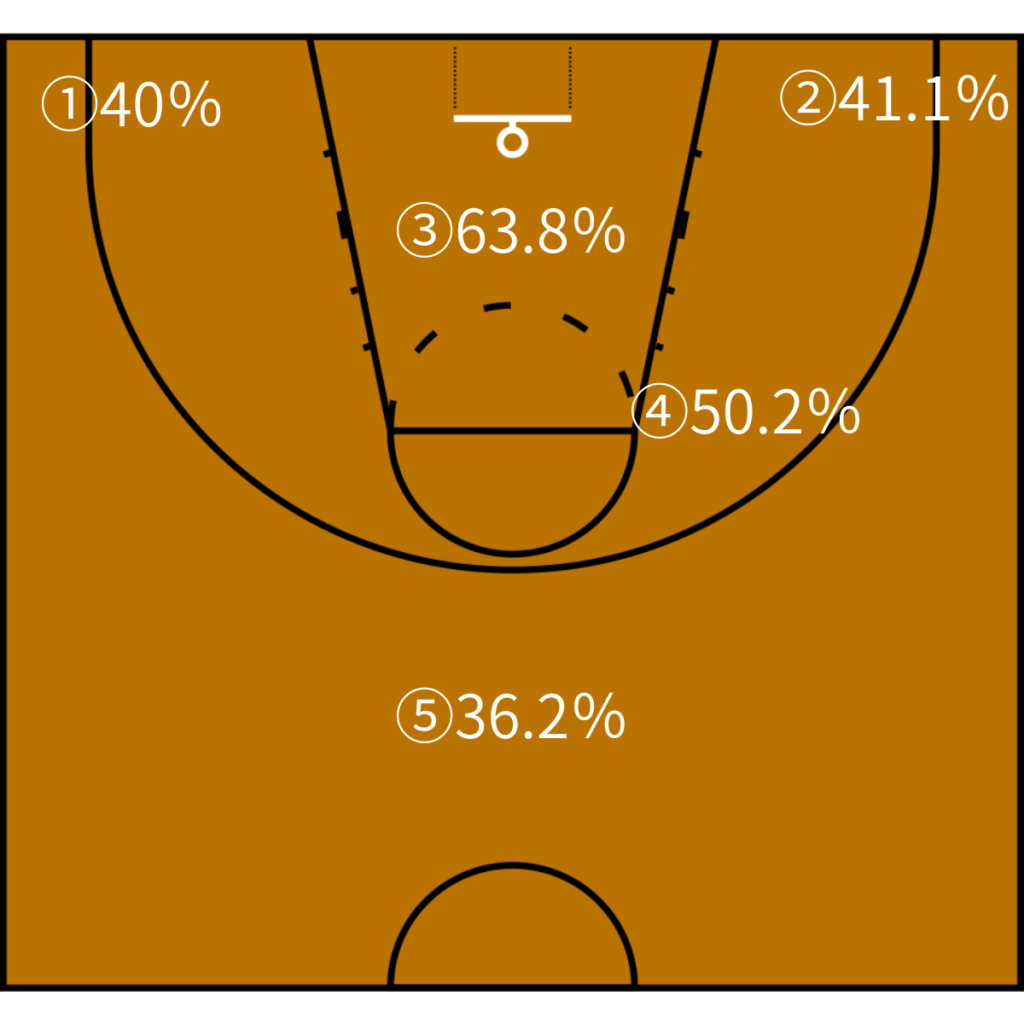
Success Rate / Number of Shots
① Left Corner 3: 14/35
② Right Corner 3: 23/56
③ Paint Area: 134/210
④ Mid-Range: 157/313
⑤ 3-Pointers Excluding Corners: 158/437
Looking at Branson’s shot chart, we can see that he attempts relatively few corner threes, but his success rate is high . Conversely, he attempts many threes from other angles, especially from the top of the key.
This suggests that Brunson is more of a player who takes the ball and orchestrates the offense himself, rather than waiting in the corner off-ball to shoot three-pointers.
The high number of shots taken from near the top of the key indicates his compatibility with plays such as isolation and pick-and-rolls, where he uses his dribbling to move the defense and create scoring opportunities .
On the other hand, his high success rate on corner threes suggests he’s not entirely bad at catch-and-shoot. Rather, Brunson’s strength lies in his ability to prioritize creating his own shots while also being able to consistently score from open corners. In the paint area, layups and floaters are his main sources of points, accounting for the majority of his total. His average 7.1 three-point attempts this season is not high compared to other star players in the same position. Maxey (PHI) has 8.6, LaMelo (MIN) has 10.3, and Doncic (LAL) has 10.8, showing that even players bigger than him make more three-point attempts, demonstrating his high scoring ability at the rim despite his relatively small stature of 188cm.
③ Which defender do you struggle against?
To identify the defenders who troubled Brunson the most, we calculated a unique “defensive score” based on points scored, field goal percentage, turnovers, and fouls allowed during matchups. The index decreases as defenders reduce Brunson’s scoring and field goal percentage, and defenders who increase turnovers are also highly rated. Conversely, points are deducted for committing many fouls against Brunson. Note that players with extremely short matchup times are susceptible to the influence of sample size, so the ranking includes players with 10 minutes or more of matchup time.
| Rank | contestant name | Matchup time | PTS/POSS(PPP) | eFG% | TOV% | Defense score (lowest first) |
| 1st | Amen Thompson(HOU) | 14:33 | 0.030 | 11.1% | 10.0% | 4.0 |
| 2nd | Dean Wade(PHI) | 10:49 | 0.115 | 6.7% | 0.0% | 9.1 |
| 3rd | Isaac Okoro(CHI) | 15:11 | 0.059 | 28.6% | 12.5% | 13.5 |
| 4th | Bilal Coulibaly(WAS) | 11:23 | 0.140 | 38.9% | 17.5% | 21.2 |
| 5th | VJ Edgecom(PHI) | 22:37 | 0.179 | 37.5% | 10.8% | 24.5 |
| 6th | Christian Brown(DEN) | 14:09 | 0.163 | 38.9% | 0.0% | 27.6 |
| 7th | Toumani Camara(POR) | 15:44 | 0.161 | 50.0% | 15.5% | 28.4 |
| 8th | Dyson Daniels(ATL) | 25:25 | 0.293 | 50.0% | 5.7% | 37.9 |
The rankings from 1st to 8th were as shown in the diagram above. It was found that effective defenders against Brunson are players with long wingspans and high athletic ability, such as Amen (HOU), or players with physicality and size, such as Wade (PHI). Conversely, players who are not effective against Brunson include those who lack size, such as Sachs (ORL) and Daveon Mitchell (TOR). It was found that players who lack size, like them, are not effective against Brunson. ④ Why can’t he be stopped?
④ Why can’t it be stopped?
At 188cm tall, he’s quite short for an NBA player. He’s often targeted defensively, and if he can’t contribute more than other players offensively, there’s a high chance he won’t be able to stay in the NBA. Yet, he averages around 26 points each year, and in the 2025-2026 season, he led his team to victory and was named Finals MVP. He’s not particularly fast, nor can he make three-pointers from anywhere with the same high percentage as Curry. So why do so many players struggle to stop him? We’ll explain from various perspectives.
- It’s not his acceleration, but his deceleration that’s on another level.
There are many players in the NBA who are good at accelerating. Players like Westbrook (who retired a while ago), Fox (SAS), and Maxey (PHI) are examples of this. On the other hand, their deceleration ability is rarely discussed. I think Brunson is one of the best players in the league when it comes to deceleration.
- Another of his strengths is his finishing ability.
In the shot chart mentioned earlier, his paint area percentage was 63.8%. This number isn’t particularly high, but it’s a good number considering his relatively small stature of 188cm. His finishing skills are diverse, and he changes his method of avoiding blocks depending on the opponent, using floaters and high grass against big men, and handoffs against guards. He is also physically strong and has good tolerance for contact. - Isolation Restart
This may be an unfamiliar term, but “Isolation Restart” simply means that after a one-on-one attack has stopped, the ball is passed to a teammate, and then another one-on-one attack is initiated from there. At first glance, you might think, “What’s the point of giving up the ball and starting a one-on-one again?” However, this move of resetting the attack has significant advantages. Instead of forcing a shot in the initial one-on-one, moving the ball once allows you to avoid difficult, tough shots and create the possibility of choosing a shot with a higher probability of success.Even more importantly, this play makes it easier to create mismatches with the defender. By moving the ball, the defender is forced to adjust their position. This slight delay or mismatch can then be used to initiate another one-on-one play. Against an opponent who couldn’t be penetrated in the initial isolation, the situation can be reset and the chances of a second chance can be seized. However, this decision is not easy. Many NBA players, when their initial one-on-one play fails, either attempt a forced shot or try to pass in a difficult situation, resulting in a turnover. In other words, the ability to choose to “restart the offense” is crucial. Among those who actively utilize this play is Jalen Brunson. Brunson doesn’t try to force an answer in his first isolation play; if the situation is bad, he moves the ball and then initiates another one-on-one play. This decision to “stop and try again” is one of the weapons that supports Brunson’s high scoring efficiency.
summary
This time, I reviewed Jalen Brunson’s play. His scoring ability, which compensated for his size and athleticism, led the NYK to victory. If you struggle to score one-on-one, definitely take note of his ball-handling, fakes, and footwork.


コメント